

Most couples have repeated the same date night formula dozens of times without noticing. Pick a restaurant. Wait for a table. Stare at menus. Watch two hours of someone else’s story. Go home. The evening was fine. You cannot remember much of it by Wednesday.
There’s a version of date night that actually changes that pattern. It’s loud, a little chaotic, and ends with paint on your shoes. And it’s consistently one of the most memorable things you can do with someone you care about. Here’s why trading your dinner reservation for a splatter session is the right call.
The Problem With “Comfortable” Dates
Routine is cozy up to a point. After that, it becomes the enemy of connection. Dinner-and-a-movie is structurally passive: you sit, you consume, you respond to stimuli someone else created. There’s almost nothing in that format that pushes two people to actually learn something new about each other.
Ask yourself: what was the last movie you two saw together that you still talk about? Now ask: what was the last thing you did together that made both of you laugh out loud in the moment? Those are different answers almost every time, and the reason is friction. Not conflict, but novelty friction – the slight discomfort and surprise of doing something you haven’t done before, together.
Paint splatter delivers that in about thirty seconds flat. The moment you pick up a brush loaded with neon blue paint and realize there is genuinely no wrong move here, something shifts. Your guard drops. So does your date’s. That’s the opening real connection walks through.
What the Science Says About Creating Together
This isn’t just a vibe. Research supports why making something with your hands changes how you feel and how you relate to the people around you. A peer-reviewed study published on the National Institutes of Health’s PubMed platform found that creative engagement was associated with significantly better cognitive functioning scores in study participants, with a beta coefficient of 0.74 (p<.001). That’s a robust association. Your brain genuinely responds differently when you’re making versus watching.
The physical act matters too. Flinging paint at a canvas – with a brush, a squeeze bottle, or your bare hand if you’re feeling bold – is a full-body action. You’re not choosing between the salmon and the steak. You’re making micro-decisions every few seconds about color, angle, and force, and none of them are wrong. That freedom is rare for adults, and it’s specifically why people leave these sessions in a noticeably better mood than when they arrived.
“The implications from this research are significant. The findings show that there is great diversity in how people engage in the arts, and this gives us a framework to use our creativity to innovate new ways to reach these audiences.” – NEA Chairman Jane Chu, via NORC at the University of Chicago
Creativity is not a personality trait you either have or don’t. It’s a state you enter. A splatter room is specifically designed to force that entry, whether you consider yourself artistic or not.
The Social Chemistry You Can’t Fake
Here’s the real reason this format works so well for dates: shared novel experiences create a sense of “we did that together” that passive activities simply don’t. You both take a canvas home. You both made something that didn’t exist before you showed up. That object becomes a reference point – a story you tell at dinner six months later when someone asks how things are going.
According to a 2024 research brief released by the National Endowment for the Arts, based on U.S. Census Bureau Household Pulse Survey data collected between April and July of that year, a quarter of U.S. adults attended at least one live, in-person arts event in the previous month, and the NEA specifically highlighted promising findings about the arts’ positive links to social connectedness. That link to connection is the whole point. A date night is a social event. Choosing an activity that actively builds connection isn’t a bonus; it’s the core of what you’re doing.
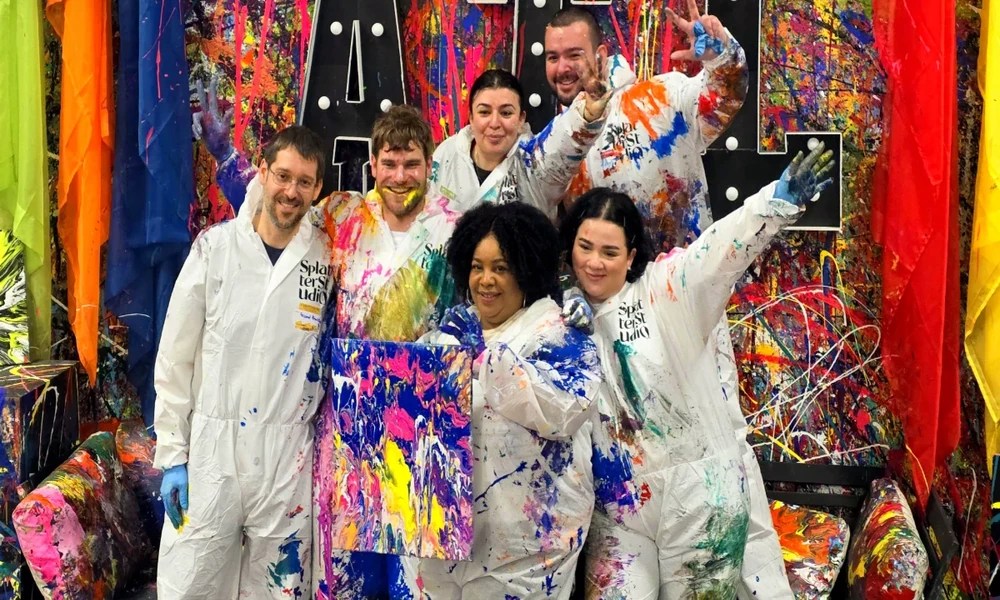
Think about what a splatter session actually looks like in practice. You walk into a room that already signals play – protective gear, bright paint, a white canvas waiting. Your default setting of adult seriousness has nowhere to hide. You’re both in ponchos. Someone flings magenta at the canvas and it goes slightly sideways. You both laugh. That laugh, especially early in a relationship, is worth more than any carefully curated restaurant ambiance.
A Real Scenario: The Date That Actually Became a Story
Picture this: it’s a third date. The first two were coffees and a brewery visit – perfectly fine, nothing wrong. The third date ends up at a paint splatter room. One person goes in skeptical (“I’m not creative”). The other is mildly excited but also mildly terrified of making a mess. They get suited up in the provided ponchos, goggles, and gloves. They’re handed cups of glow-in-the-dark paint. And then – nothing. No instructions except to go for it.
The skeptic makes the first move. A tentative flick. Then a harder one. Then an absolutely reckless full-arm throw of orange across the canvas that sends both of them into genuine, unscripted laughter. By the end of the session, they’ve made something ugly and specific to exactly that evening. They took it home. It’s still on someone’s wall. That’s not a dinner-and-a-movie story. That’s the kind of date night that gets repeated out loud.
For anyone in Denver specifically, the All Out Smash Splatter Room is exactly this kind of experience – a dedicated space where glow-in-the-dark paint, take-home canvases, and full protective gear are already part of the deal, removing every logistical excuse not to do it.
The Canvas vs. Check Decision Matrix
If you’re still weighing your options, run both through this framework. These five dimensions track what actually matters for a memorable shared evening:
| Dimension | Dinner + Movie | Paint Splatter Date Night |
|---|---|---|
| Novelty | Low (familiar format) | High (most people have never done it) |
| Active participation | Passive (watching, eating) | Fully active (making, throwing, laughing) |
| Memorable story generated | Low (generic) | High (specific, personal, visual) |
| Pressure on conversation | High during dinner, none during movie | Low (activity carries the energy) |
| Tangible keepsake | None | A canvas you actually made together |
The matrix tells a pretty clear story. Five for five, the splatter session wins on dimensions that actually predict whether a date sticks in memory.
How to Make It Work: A Simple Checklist
- Book in advance. Popular slots fill up, especially weekends. Don’t walk in assuming availability.
- Wear clothes you don’t care about under the provided poncho. Some paint still finds a way.
- Agree beforehand to go for it. The biggest mistake couples make is playing it safe. The uglier and bolder the canvas, the better the story.
- Pick your colors intentionally. Glow-in-the-dark options change how the piece looks in different lighting – worth thinking about before you start.
- Take a photo before you leave. The canvas looks different after it dries. Document it while the paint is still wet.
The NEA’s 2024 data found that 16.3% of U.S. adults created, practiced, or performed artworks in the previous month – a number that reflects genuine creative participation, not just passive consumption. That’s a significant chunk of the population already discovering that making something beats watching something. You might as well be one of them, and bring your date along.
The Takeaway
Dinner is not the enemy. Movies are fine. But if you want a date night that generates an actual memory – one with a specific moment, a specific laugh, and a physical object to prove it happened – you already know which format wins. Book the splatter session. Wear the poncho. Throw the paint. Your date will remember it. So will you.