
Denture wearers rarely ask how their teeth were made. They do notice when a base rocks on the ridge, when the palate feels bulky, or when the acrylic starts to smell after a few months. Many of those complaints trace back to the way conventional bases are processed, and that is the main reason labs have been moving to bases milled from pre-cured pucks. Aidite denture PMMA discs are one example of the material behind that shift, sold to labs that design dentures on screen and cut them on a milling machine.
The change has been gradual. Plenty of dentures are still packed and boiled the old way, and some technicians produce beautiful work with nothing more than a flask and a press. Still, the arguments for milling have become hard to ignore, from fit and hygiene to the simple ability to make a second copy without a new impression.
Why Does Heat-Cured Acrylic Shrink and Warp?
Conventional denture acrylic starts as a powder and a liquid. Mixed together, they form a dough that the technician packs into a plaster mold, presses shut and cures in hot water. As the monomer turns into polymer, the material contracts. Stresses get locked inside the base, and some of them relax when the denture is deflasked and cooled.
The result is small but familiar: a posterior palatal seal that lifts slightly, a flange that no longer hugs the ridge, or a bite that has shifted by the time the teeth are checked on the articulator. On top of that, every hand-mixed batch differs a little in powder to liquid ratio, temperature and timing, and porosity can creep in when any of them drift.
Leftover monomer is a separate concern. Residual monomer is what gives some new dentures an odd taste, and in a small number of patients it can irritate the tissue under the base.
Is a Milled Base Any Different from a Flasked One?
A milled base is carved from a disc that was polymerized in a factory under controlled heat and pressure. All the shrinkage happens there, long before the disc reaches the lab. The milling machine simply removes material until the designed shape is left, so the base comes off the mill at the dimensions in the file.
Published lab studies have generally found that pre-polymerized CAD/CAM bases fit the cast at least as closely as conventional ones, with fewer internal voids and lower residual monomer. Denser material also tends to pick up less stain and fewer microbes over time, which matters for older patients who struggle with cleaning. Results vary by material and machine, so the evidence is best read as a general trend with exceptions.
Each manufacturer publishes its own test figures. Aidite denture base PMMA, for instance, is described by its maker as a highly cross-linked material with low residual monomer. Cross-linking, monomer content and water sorption are the properties worth comparing across brands, using the numbers on each product’s own data sheet.
Which Aidite Denture PMMA Discs Cover Bases, Teeth and Splints?
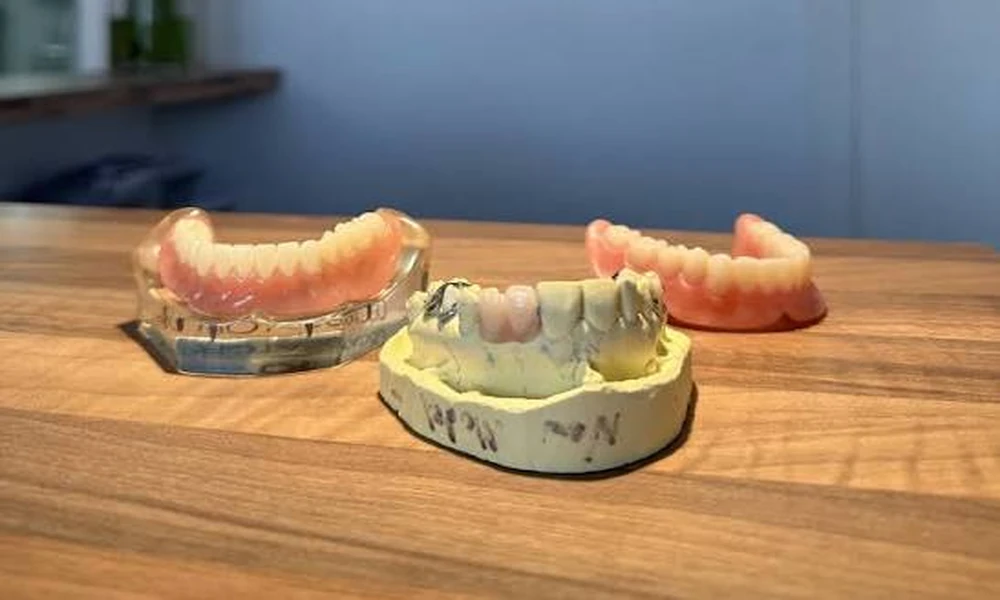
Aidite, a Chinese maker of CAD/CAM dental materials, lists several resin products that matter here. The denture base discs come in pink gingival shades and a range of thicknesses, with fibers added to imitate the fine veining of natural gum tissue. The company also lists a denture disc that combines tooth-colored and base material in one puck, bonded during manufacture, so a complete arch can be milled in a single piece and finished by polishing.
For appliances that should be nearly invisible, Aidite clear PMMA is a colorless disc the maker positions mainly for occlusal splints.
Distributor catalogs sometimes group these products as Aidite denture resin blocks, although the format most open milling systems take is a round disc. Before ordering, check that the disc diameter and holder suit your machine and that the indications on the label match the work you plan to cut.
Can a Lab Remake a Lost Denture from the Saved File?
With a conventional denture, the shape lives only in the finished appliance and perhaps a stone cast. If the denture is lost, cracked or left on a hotel nightstand, the dentist usually starts again with impressions and try-ins.
A digital denture leaves a design file behind. As long as the patient’s tissues have not changed much, the lab can mill a spare from that file on the same Aidite denture PMMA discs or whichever base material it stocks, often with very little chair time. Care homes in particular like the idea of a backup set, since dentures there go missing with surprising regularity.
The file also helps when an old denture needs replacing. Dentists can scan a well-liked existing denture, adjust the design, and keep the features the patient was used to, such as tooth position and palate thickness.
Do Patients Notice a Difference in Fit and Comfort?
Many do. A base that fits closely tends to feel more stable during chewing and speech, which can mean fewer sore spots at the first adjustment visit. Some milled designs can also be made slightly thinner across the palate, which patients notice right away when they talk or taste food.
Fewer appointments are another practical gain. Depending on the workflow, a digital case can combine steps that used to need separate visits, such as recording the bite and choosing the tooth setup. Labs working with PMMA denture material from Aidite or similar discs still need a try-in, usually a printed or milled trial denture, because esthetics and the bite must be approved before the final base is cut.
Expectations should stay realistic. Resorbed ridges, dry mouths and strong gag reflexes remain hard cases, however the base is produced. Milling improves the material and the accuracy, and the clinical skill in recording the impression and bite still decides how well the denture works.
Are Conventional Acrylic Dentures Still Made Today?
Yes, and they will be around for some time, especially for relines, repairs and labs without a milling unit. Conventional acrylic is cheaper to set up, easy to adjust at the chair and familiar to every technician. Digital dentures built from pre-cured PMMA are taking over a growing share of new complete dentures because they fit predictably, carry less residual monomer and can be reproduced from a file. For most labs the practical path is a mix of both methods, with milling handling new cases and the bench handling the repairs that conventional acrylic still does well.
____________________________________________________________________________________________